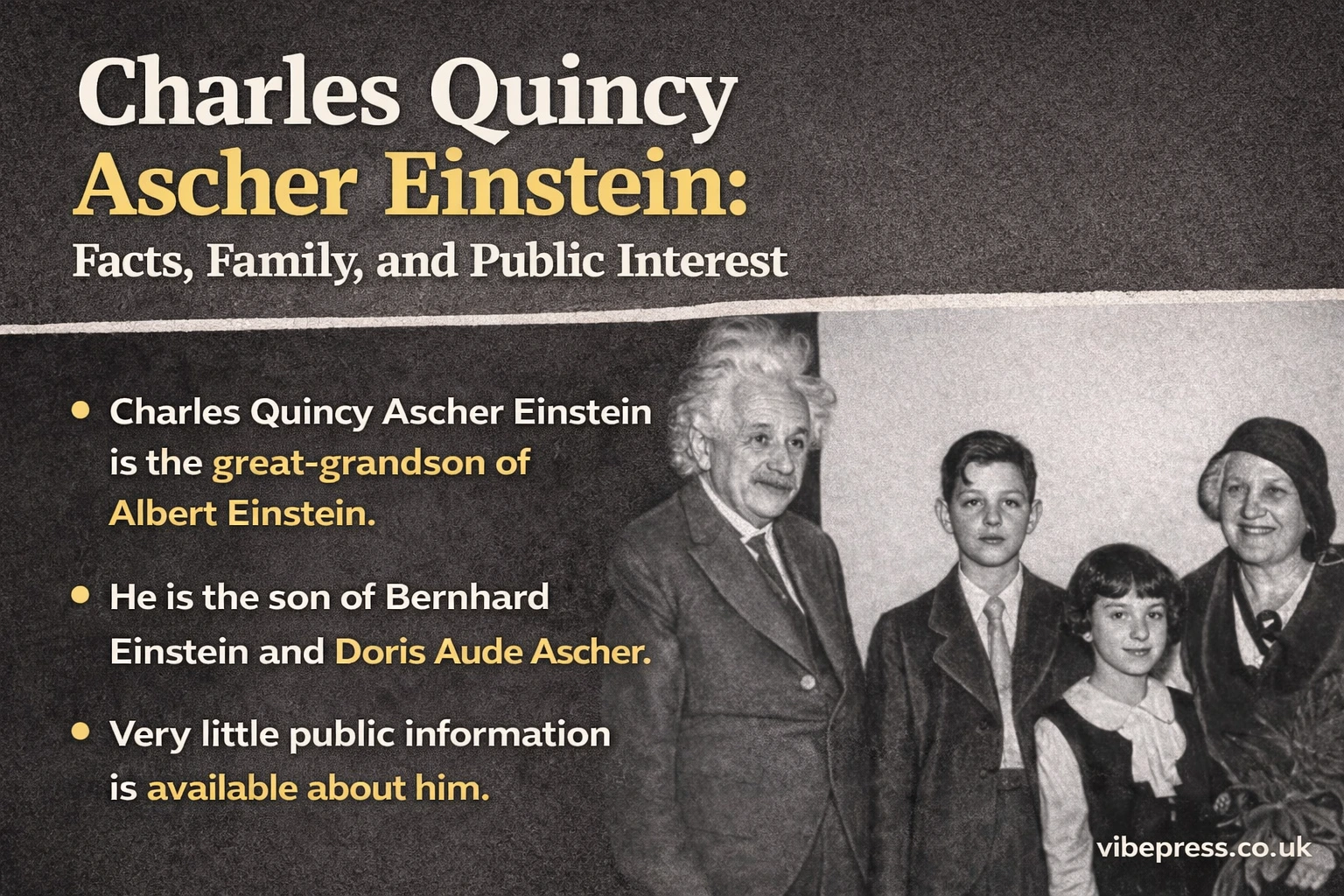
Charles Quincy Ascher Einstein is a name that often appears in online searches because of one powerful connection: the Einstein family. Many people want to know whether he is related to Albert Einstein, what his background is, and why so little public information exists about him.
The available evidence shows that Charles Quincy Ascher Einstein is part of Albert Einstein’s biological family line through Hans Albert Einstein and Bernhard Caesar Einstein. Public records and family references identify him as one of Bernhard Caesar Einstein’s children, with Doris Aude Ascher as his mother. Bernhard was the son of Hans Albert Einstein, who was Albert Einstein’s son. That makes Charles Quincy Ascher Einstein a great-grandson of Albert Einstein.
Even so, there is a major difference between being related to a world-famous figure and being a public figure yourself. In this case, the second point matters most. Publicly available information about Charles Quincy Ascher Einstein is extremely limited, and that shapes any honest discussion of his life.
Who Is Charles Quincy Ascher Einstein?
Charles Quincy Ascher Einstein is most commonly identified in public sources as a descendant of Albert Einstein through the physicist’s son Hans Albert Einstein and grandson Bernhard Caesar Einstein. Public genealogical listings and family references place him among Bernhard’s children.
His name sometimes appears with the nickname “Charly” in family-related references. One widely cited family summary attached to Bernhard Einstein lists Charles Quincy Ascher “Charly” Einstein among Bernhard’s five children.
Because the surname Einstein draws attention on its own, search interest around Charles Quincy Ascher Einstein tends to be driven more by family legacy than by a large public record of his own. That is why many online readers find repeated references to lineage but very little verified detail about his personal life, work, or public activity.
The Einstein Family Connection
To understand why the name stands out, it helps to look at the family line clearly.
The direct family line
The documented line is usually presented like this:
- Albert Einstein
- Hans Albert Einstein
- Bernhard Caesar Einstein
- Charles Quincy Ascher Einstein
This structure is supported by public family references and Bernhard Einstein’s biographical summaries. Hans Albert Einstein was Albert Einstein’s son, and Bernhard Caesar Einstein was Hans Albert’s son. Bernhard’s listed children include Charles Quincy Ascher Einstein.
Why this relationship matters
Albert Einstein remains one of the most recognized names in science. Because of that, any descendant with the Einstein surname tends to attract curiosity. Readers often want to know whether family members followed scientific careers, stayed in public life, or carried forward the legacy in visible ways.
Yet public interest does not always produce public documentation. In the case of Charles Quincy Ascher Einstein, the family link is the strongest confirmed fact available in open sources, while deeper personal details remain scarce.
What Public Sources Confirm
When researching a little-known person tied to a famous family, the best approach is to separate confirmed information from repeated speculation. For Charles Quincy Ascher Einstein, a few points appear consistently across the limited public record.
1. He is linked to the Einstein bloodline
Bernhard Caesar Einstein’s public family information identifies Charles Quincy Ascher Einstein as one of his children. Bernhard himself was the son of Hans Albert Einstein, who was Albert Einstein’s son. That places Charles within the direct biological line of Albert Einstein’s descendants.
2. His mother’s surname appears in his full name
The middle portion of the name, “Ascher,” appears connected to his mother, Doris Aude Ascher. Public family records list Bernhard Caesar Einstein and Doris Aude Ascher as his parents.
3. He belongs to a private branch of a famous family
A 2008 Discover Magazine piece on Albert Einstein’s descendants described the family as private and included a statement from Aude Ascher Einstein expressing that the family did not want people writing about them because it would be hurtful and disruptive. That source does not center on Charles specifically, but it strongly supports the broader point that this family branch has guarded its privacy.
4. Public detail is limited
Reliable open-web material does not provide a full public biography, detailed professional profile, or a long documented timeline for Charles Quincy Ascher Einstein. The available information is narrow and mostly family-based.
Why People Search for Charles Quincy Ascher Einstein
Search interest around this name usually comes from three main reasons.
Curiosity about Einstein descendants
Albert Einstein’s descendants have long attracted public attention. Readers want to know whether later generations entered science, lived quietly, or took entirely different paths. That curiosity often leads to searches for lesser-known family members.
Confusion caused by scattered online references
A name like Charles Quincy Ascher Einstein appears across genealogy pages, reposted family summaries, and search snippets. That mix can make the person seem highly documented even when the actual source base is thin. Some pages repeat the same few facts without adding reliable new information.
Interest in legacy and inheritance of fame
People often assume that descendants of major historical figures inherit public roles, influence, or visibility. In reality, many relatives of famous people choose private lives. The Einstein name sparks attention, but not every family member becomes a public personality. The limited record around Charles Quincy Ascher Einstein is a good example.
Bernhard Caesar Einstein and the Family Context
Any discussion of Charles Quincy Ascher Einstein usually leads back to his father, Bernhard Caesar Einstein, because Bernhard is the most documented link in this family branch.
Bernhard Caesar Einstein was born in 1930 and died in 2008. He was the son of Hans Albert Einstein and the grandson of Albert Einstein. Public summaries describe him as a Swiss-American engineer who studied at UC Berkeley and ETH Zurich and later worked in technical fields including electronics, light amplification, and laser-related work.
Bernhard’s family record is important because it anchors Charles Quincy Ascher Einstein in a verifiable lineage. Public references list Bernhard and Doris Aude Ascher as parents of five children, including Charles.
This matters for two reasons:
- It confirms that Charles Quincy Ascher Einstein is not just an internet rumor or invented name.
- It also shows that most available information comes from family listings rather than from a broad public profile.
Was Charles Quincy Ascher Einstein a Scientist?
This is one of the most common implied questions behind the search term. People often expect that an Einstein descendant may have entered physics, engineering, or another scientific field.
At present, reliable public sources do not provide strong evidence to support a detailed claim about Charles Quincy Ascher Einstein’s profession, major public achievements, or scientific career. Because the verified public record is so limited, it would be unsafe to present him as a scientist, engineer, academic, or public intellectual without stronger sourcing.
That lack of evidence should not be mistaken for lack of accomplishment. It simply means open sources do not document his life in a way that justifies confident public claims.
A Private Life in a Famous Family
One of the most useful ways to understand Charles Quincy Ascher Einstein is through the idea of privacy.
The public often treats famous family names as permanent public property. Yet descendants may choose a very different path. The Discover Magazine reporting about this branch of the Einstein family suggests that privacy has been important to them, and that public attention can be unwelcome.
That context explains why online searches produce only a narrow profile:
- A family connection
- A few genealogical references
- Very little personal detail
- No strong public-facing biography in major mainstream sources
For researchers, bloggers, and readers, this is a reminder that historical interest does not erase personal boundaries.
Common Misinformation Risks Around This Name
When a person is little known but tied to a famous surname, misinformation spreads easily. Charles Quincy Ascher Einstein is a strong example of that problem.
Repeated claims without original sourcing
Many websites copy family details from one another. Once a name, date, or relationship appears in one place, it can spread widely even if later pages do not verify it independently. That is why high-trust sourcing matters.
Assumptions based on the Einstein surname
Some writers move too quickly from family relation to professional identity. A person related to Albert Einstein is not automatically a physicist, inventor, or public lecturer. Without reliable proof, those claims remain speculation.
Mixing genealogy with biography
Genealogical records can help confirm family links, but they do not always provide a complete life story. For Charles Quincy Ascher Einstein, genealogy helps establish the family line, while deeper biographical detail remains limited.
Read more: What Is Kupybzv? Meaning and Facts to Know
How to Research Charles Quincy Ascher Einstein Responsibly
If you are trying to learn more about Charles Quincy Ascher Einstein, it helps to use a careful method.
Start with confirmed family links
Begin with public family sources that connect Albert Einstein, Hans Albert Einstein, Bernhard Caesar Einstein, and Charles Quincy Ascher Einstein. These establish the core relationship.
Prefer reputable secondary coverage
Use trusted reporting that discusses the Einstein family and its privacy, such as the Discover Magazine piece about Albert Einstein’s descendants. That source gives useful context about why details are scarce.
Avoid unsupported personal claims
Be cautious with websites that claim exact jobs, private addresses, or personal life details without clear sourcing. When a reliable source base is weak, the safest conclusion is often the simplest one: the family link is documented, but the public biography is not.
Separate fact from assumption
A sound summary should distinguish between:
- Confirmed: family relationship, parentage, lineage
- Unclear: career details, public role, personal biography
- Unsupported: dramatic stories or detailed claims without trustworthy sources
This approach keeps the topic accurate and respectful.
Why the Name Keeps Appearing Online
The name Charles Quincy Ascher Einstein has a strong search pattern because it combines two things that attract attention fast: rarity and historical fame.
“Charles Quincy Ascher” is distinctive on its own, while “Einstein” is globally recognized. That makes the phrase memorable, searchable, and easy for curiosity-driven content to target. The result is a lot of interest, even though the amount of solid public information is small.
This mismatch between high search curiosity and low verified detail is exactly why many pages about Charles Quincy Ascher Einstein feel repetitive. They often circle the same core point: he is part of Albert Einstein’s family, but he is not widely documented as a public figure.
Key Facts at a Glance
Here are the most useful points readers should know:
- Charles Quincy Ascher Einstein is publicly identified as a descendant of Albert Einstein.
- He is linked through Hans Albert Einstein and Bernhard Caesar Einstein.
- His parents are listed as Bernhard Caesar Einstein and Doris Aude Ascher.
- Public information about his personal life is limited.
- The Einstein family branch tied to Bernhard appears to have valued privacy, which likely explains the lack of detailed public coverage.
What Readers Should Not Assume
A good summary also needs to cover what is not established.
Do not assume he had a public science career
There is no strong, widely trusted public evidence that Charles Quincy Ascher Einstein built a major public identity in science, academia, or media. The family name alone is not enough to support that claim.
Do not assume every online biography is reliable
Many pages repeat the same small pool of facts. That does not automatically make them accurate or complete.
Do not confuse family connection with public prominence
The strongest confirmed point is lineage. Beyond that, the record becomes much thinner.
FAQ About Charles Quincy Ascher Einstein
Is Charles Quincy Ascher Einstein related to Albert Einstein?
Yes. Public family references place him in Albert Einstein’s biological family line through Hans Albert Einstein and Bernhard Caesar Einstein. That makes him a great-grandson of Albert Einstein.
Who were Charles Quincy Ascher Einstein’s parents?
Public family listings identify his parents as Bernhard Caesar Einstein and Doris Aude Ascher.
Why is there so little information about Charles Quincy Ascher Einstein?
The available public record is limited, and reporting on this branch of the Einstein family suggests they valued privacy. That likely explains why detailed personal information is scarce online.
Was Charles Quincy Ascher Einstein a physicist like Albert Einstein?
There is no strong public evidence that supports a detailed claim that he became a physicist or another public scientific figure. Reliable open sources mainly confirm his family connection, not a public career profile.
What does “Ascher” in his name refer to?
Public records connect “Ascher” to his mother, Doris Aude Ascher, whose surname appears in family references.
Is Charles Quincy Ascher Einstein a public figure?
Not in the usual sense. Publicly available information about him is narrow, and there is no strong open-web record showing a major public-facing role.
Why do people search for Charles Quincy Ascher Einstein?
Most searches appear to come from curiosity about Albert Einstein’s descendants, interest in the Einstein family line, and confusion caused by scattered or incomplete web references.
Conclusion
Charles Quincy Ascher Einstein is best understood as a documented member of Albert Einstein’s family rather than as a widely profiled public figure. Public sources support his place in the family line through Bernhard Caesar Einstein, Hans Albert Einstein, and Albert Einstein himself. At the same time, the available record about his personal life remains limited, and that privacy should shape how the topic is discussed.
The most accurate takeaway is simple: Charles Quincy Ascher Einstein is a real part of the Einstein family story, but the public knows far less about his private life than many search results suggest.